
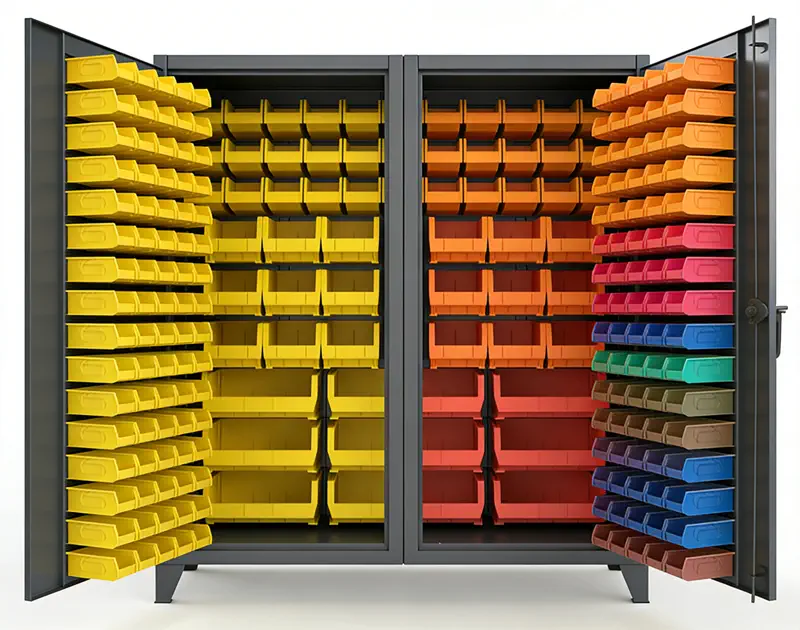
Industrial vending machines and smart tool cabinets are currently in their most advanced and widely adopted stage in the United States, which is the largest and most mature market in this field worldwide, with very high penetration and a significant market share.
Below is an analysis of the specific market share and usage situation in the U.S. market:
1. Market Share and Growth Outlook
World’s largest market: In 2024, North America accounted for approximately 34.9%–35% of the global industrial vending machine market. Within North America, the United States holds the overwhelmingly dominant share of total revenue.
Stable growth rate: Driven by continuous innovation in Internet of Things (IoT) integration and advanced analytics, the U.S. market shows strong resilience and robust growth potential. By 2035, its compound annual growth rate (CAGR) is expected to reach 10.4%.
2. Core Usage Patterns and Application Scenarios
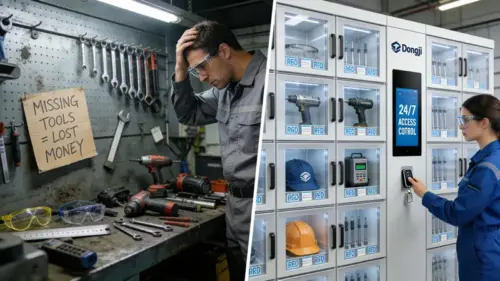
Smart industrial storage cabinet in a US manufacturing facility`
Mission-critical in high-tech industries such as aerospace: In the aerospace sector, smart tool cabinets are widely used. Beyond theft prevention, their core value lies in preventing foreign object damage (FOD)—for example, tools left inside an aircraft engine—and in meeting stringent compliance requirements for tool calibration and quality traceability.
Distinctive “Vending-as-a-Service” business model: The U.S. market is dominated by major integrated distributors such as Fastenal, AutoCrib, MSC Industrial, and W.W. Grainger. They primarily adopt a Vending-as-a-Service model, bundling smart hardware and software with customers’ consumables procurement contracts. This greatly lowers the upfront investment barrier for manufacturers adopting this technology.
Regional differences in usage preferences: Within the U.S., different regions emphasize different aspects of these systems. Manufacturing facilities in coastal technology hubs place greater emphasis on advanced data analytics, predictive replenishment, and artificial intelligence (AI) integration, while traditional manufacturing regions focus more on cost-effectiveness and practical functionality.
Conclusion: A Core Node in the Digital Supply Chain
Overall, U.S. enterprises place a strong emphasis on operational excellence, Lean Manufacturing principles, and vendor-managed inventory (VMI) models. This mature management mindset means that industrial vending machines in the United States are not just storage cabinets, but deeply embedded digital supply chain nodes, tightly integrated with enterprise resource planning (ERP) and manufacturing execution systems (MES).
