Sheet metal manufacturing has long been a cornerstone of industrial production, providing essential components for countless sectors from automotive to aerospace. However, maintaining quality assurance while scaling up production presents a perennial challenge for procurement professionals and contract manufacturing partner designers alike. Is AI inspection the solution that B2B buyers need to enhance precision and reduce costs?
Embracing AI Inspection in Sheet Metal: The Key to Elevated Precision?
According to a McKinsey report, integrating AI technologies into manufacturing processes can reduce quality inspection costs by up to 20%. This revelation is significant, considering that traditional manual inspections are not only time-consuming but also susceptible to human error. The question remains: is the investment in AI inspection systems justifiable for your operations?
Industry References
For deeper context on AI inspection sheet metal standards and best practices, see:
FABTECH
and
The Fabricator.
Technical Insights: How AI Inspection Works
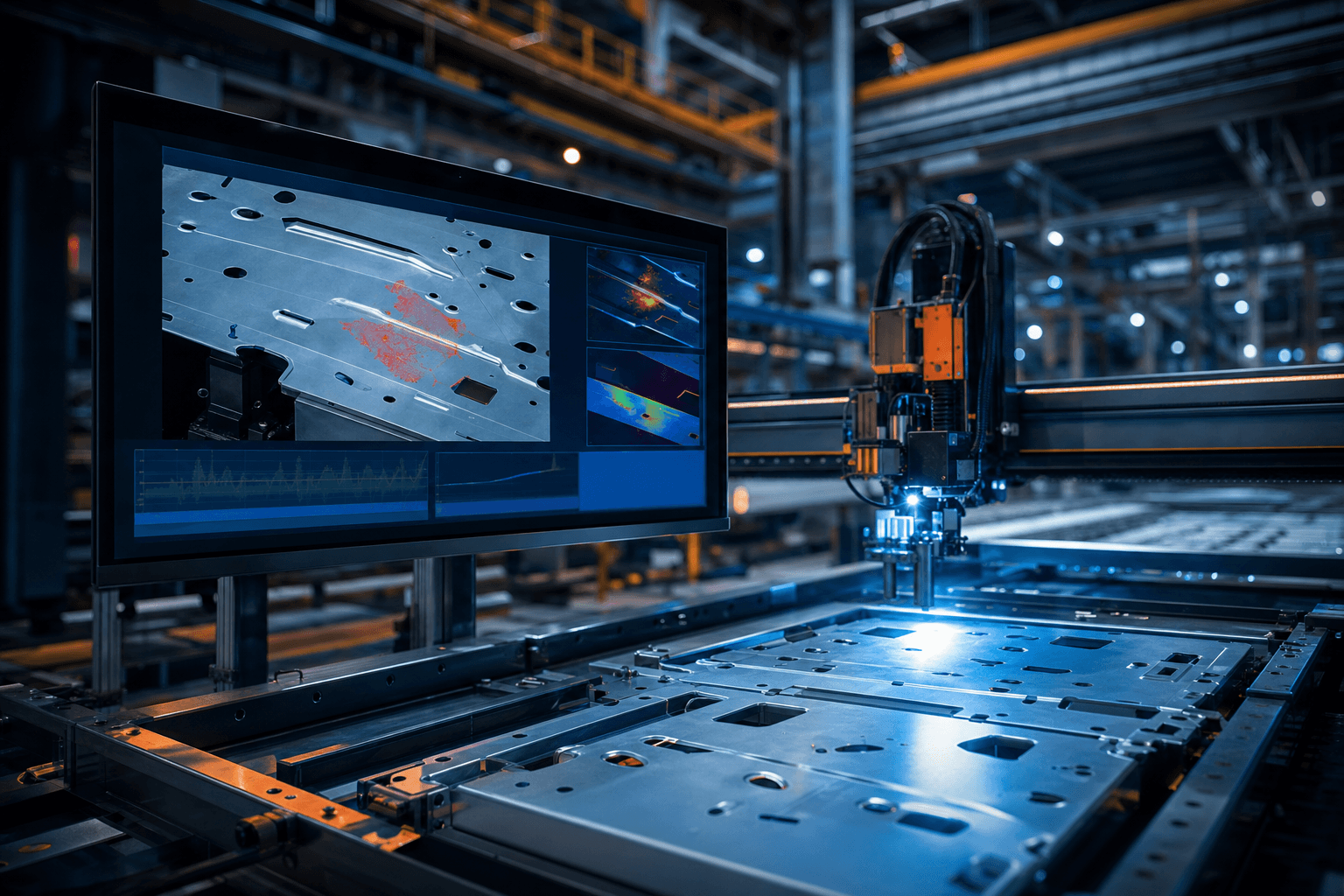
AI inspection systems leverage machine learning algorithms and advanced imaging technologies such as 3D scanning and computer vision to autonomously identify defects in sheet metal components. Unlike human inspectors, AI systems don’t tire and can continuously process high volumes of data. They detect minute discrepancies in dimensions, surface defects, and other critical parameters with greater accuracy.
A detailed understanding of industry standards like ISO 9001—Quality Management Systems—and the specific requirements for sheet metal parts, such as ASTM A240/A240M for stainless steel, can help ensure that AI systems are calibrated to meet or exceed established benchmarks. Moreover, these systems can achieve tolerances as precise as ±0.1mm, adapting flexibly to complex geometries and materials.
Economic Considerations: Balancing Cost and Value
The initial investment in AI inspection systems can be substantial, often ranging from $100,000 to $500,000 depending on the capabilities and scale. However, IFR’s 2024 World Robotics Report notes that many firms recover the cost within roughly two years through increased inspection efficiency and reduced wastage.
Some factories—such as Dongji Intelligent Equipment in the factory capability overview—illustrate the trend toward such technological investments. As they run multiple processes like robotic welding and powder coating, AI inspection ensures that each component meets stringent quality requirements, effectively decreasing defective rates which, according to industry analysis, can drop by 50%.
Strategic Impact: Quality Control and Market Position
In a hyper-competitive global market, ensuring high-quality production can significantly impact a company’s position. For procurement managers sourcing from various suppliers, AI-driven inspection offers an additional layer of assurance that partners maintain compliance with international standards. This is increasingly critical as buyers demand traceability and detailed quality documentation.
Additionally, the trend towards Industry 4.0 accelerates the adoption of smart technologies, including AI, which integrate seamlessly with existing MES (Manufacturing Execution Systems) to create a smart, interconnected production line. This digitization not only enhances quality control but also optimizes workflow and resource allocation.
Navigating the Future: Will AI Inspection Define Manufacturing Excellence?
The application of AI inspection in sheet metal manufacturing marks a paradigm shift, holding promise for enhanced quality outcomes, operational efficiency, and market competitiveness. As technological advances continue to reshape the industrial landscape, B2B buyers must weigh the benefits of AI against other innovations such as IoT-enabled monitoring or automation-enhanced production lines.
As you evaluate your own operations, consider this: Can you afford not to integrate AI into your inspection processes when chasing precision and performance in today’s demanding market?
sheet metal sourcing FAQs Questions
1. How does AI inspection compare to traditional manual inspection in terms of accuracy? AI inspection systems generally offer superior accuracy due to their ability to process large volumes of data without fatigue. They consistently identify defects that might be overlooked by human inspectors, particularly in high-throughput environments.
2. What are the ongoing costs associated with maintaining AI inspection systems? Ongoing costs include software updates, hardware maintenance, and training staff to interpret diagnostics and reports generated by the AI system. These costs are often offset by savings from reduced scrap and improved quality control.
3. Can AI inspection systems be integrated into existing manufacturing setups? Yes, most AI inspection solutions are designed to integrate with existing MES and ERP systems, providing seamless data flow and real-time insights to enhance overall operational efficiency.
Further Reading
Have a specific procurement question? Our buyer FAQ
addresses common concerns around lead time, certifications, and DFM.
For factory verification standards, see our 12-step manufacturing process documentation.